Frequency Illusion or Synchronicity?
Cognitive Bias Meets Cosmic Wonder

Reading time: 6 minutes
punditman says…
A few months ago, I was sitting in the hockey dressing room post-game, explaining that the reason I’d been absent for over three months was due to my first-ever case of gout.
According to Harvard Health Publishing, gout is an arthritic condition so excruciating it can turn a single joint into a swollen, “fiery epicenter of agony.” For some, it’s a minor one-off that clears in a few days. For others, it’s an ongoing battle to keep flares at bay, lasting anywhere from days to months.
I’d done a real number on my foot—traumatizing the MTP joint by playing tennis two days in a row, unaware that a flare had already started. I hadn’t been able to get a shoe on my swollen foot, let alone a skate.
But this isn’t a pity party. I was just happy to finally get the right meds and be able to walk without a cane. Skating was a bonus.
Then, while I was recounting the ordeal, something curious happened.
The custodian who was mopping the floor overheard our chat. He explained that he himself had very bad gout, showed us his deformed feet, and said he was awaiting surgery. At just 36 years old, the poor fellow had the misfortune of winning the gout lottery as a teenager.
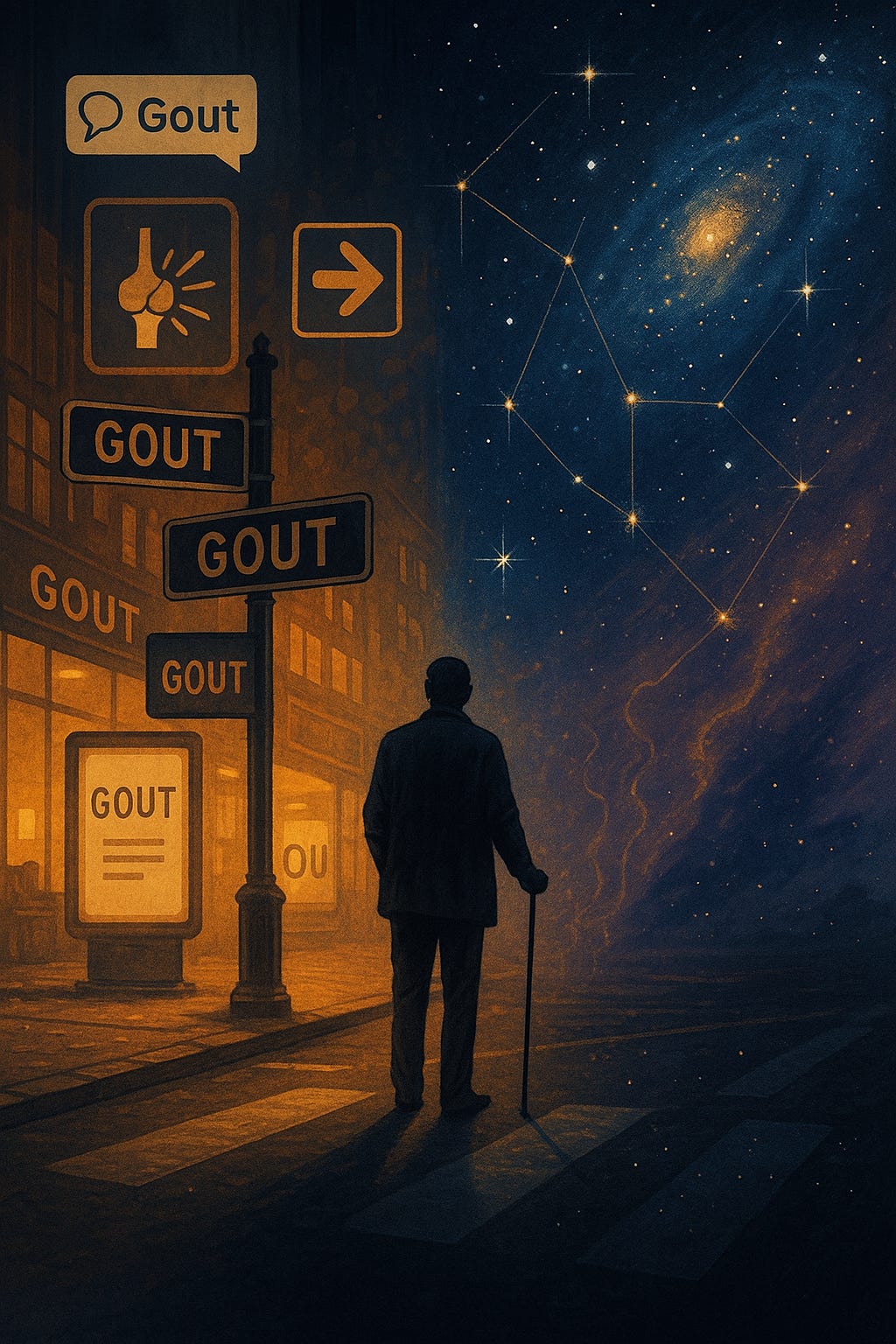
But here’s the thing: this “coincidence” wasn’t the first. Since my episode began, it seemed like every other person I spoke to had experienced gout or knew someone who had. This included about half a dozen friends and acquaintances, my landlord, a stranger outside the pharmacy, random sports fans—you name it. It was uncanny. Granted, I was explaining why I was hobbling around, so it’s no wonder the topic came up.
Still, I had no idea gout was that common. Turns out it affects as many as one million Canadians—or around 2–4% of the population—and is the most common form of inflammatory arthritis.
And yet, given all the possible foot problems—orthopaedic injuries, neurological disorders, post-op recovery—the chances that someone would not only share my specific diagnosis but offer up their own far more extreme version of it (on top of all the other cases I’d heard about) made me feel like the universe was nudging me to pay closer attention. But to what?
Cognitive science calls this the Baader-Meinhof Phenomenon. It’s what happens when you become acutely aware of something—a word, an idea, an experience—and suddenly you start noticing it everywhere. According to this theory, the thing itself isn’t actually appearing more often; your brain is just more attuned to it, making it seem more prevalent.
The term has a curious origin: it was coined in 1994 by a commenter on the St. Paul Pioneer Press online discussion board, who noticed that after hearing the name of the 1970s German militant group Baader-Meinhof once, it began popping up all over his media landscape. Then in 2005, Stanford linguist Arnold Zwicky gave the effect its more formal academic label: Frequency Illusion.
Our brains are wired to detect patterns. Once something enters our awareness, we unconsciously filter the world to notice it more. It’s one of those mental shortcuts, designed to streamline the way we process information.
Now to Blame Social Media for All the World’s Ills—Again!
We live in a world where the Baader-Meinhof Phenomenon is artificially amplified by algorithms designed to feed users content based on recent searches and interactions. This creates a feedback loop where we perceive certain topics as more prevalent than they really are, leading to skewed perceptions of reality.
In a recent MasterClass interview, Noam Chomsky was asked about the dangers of algorithms and echo chambers:
“When you go to your favourite reinforcing bubble, you’re just hearing your own views replicated and expanded and so on. In fact, it’s polarizing and driving people even to more extreme views. When you’re sort of isolated alone, you can’t think things through and figure things out.”
Such amplification underscores the importance of recognizing how external systems manipulate our cognitive biases.
Not that we don’t already know this. But like this stubborn late-spring cold weather, no one seems to be doing much about it.
On the Other Hand…
Carl Jung and other thinkers might argue that what I’ve described here could be synchronicity—a meaningful connection between events that isn’t just probability or statistical noise. Jung believed that some coincidences carry psychological or even metaphysical significance, hinting at an underlying order to reality.
He developed the concept with physicist Wolfgang Pauli. Together, they proposed the Pauli–Jung Conjecture: that both the physical and psychological emerge from a deeper, unified reality.
This idea resonates with physicist David Bohm’s theory of the holomovement, which posits that all phenomena are projections from a deeper, implicate order—a fundamental interconnectedness underlying the universe.
YouTube is bursting with New Agers who echo these views. Grifters, flakes, and A.I. scams are there, but so are voices that are surprisingly grounded and insightful.
Albert Einstein is often credited with asking what he considered the most important question: “Is the universe a friendly place?”
Though the attribution is debated, the sentiment still resonates. And how we answer shapes not just our worldview, but our actions:
“For if we decide that the universe is an unfriendly place, then we will use our technology, our scientific discoveries and our natural resources to achieve safety and power by creating bigger walls to keep out the unfriendliness and bigger weapons to destroy all that which is unfriendly...”
“If we decide that the universe is neither friendly nor unfriendly... then we are simply victims to the random toss of the dice and our lives have no real purpose or meaning.”
“But if we decide that the universe is a friendly place, then we will use our technology... to create tools and models for understanding that universe. Because power and safety will come through understanding its workings and its motives.”
“God does not play dice with the universe.”
It’s here, perhaps, that the notion of synchronicity gains deeper resonance. Seen through this lens, what we sometimes label “coincidences” could be echoes from a deeper pattern—a whispered reminder that we’re woven into something larger than ourselves.
Of course, if you lean toward materialist explanations, the Baader-Meinhof effect may be all the clarity you need.
But if you're open to something else—the collective unconscious, spiritual intuition, or simply the peculiar mysteries of life—then synchronicity might just be your cup of herbal tea.
And maybe these quirky little moments are nudging us—not toward certainty, but toward connection and compassion. Something the world could use in generous doses right about now.
As Kurt Vonnegut quipped:
“We’re here to help each other get through this thing, whatever it is.”
Poll: Best Day of the Week for Punditman to Post?
Thank you so much for reading! If you enjoyed this article and want to encourage Punditman to keep going, you can buy me a coffee below. Every little bit helps!
Ever since my daughter got her Tesla it seemed like I was seeing those things on the highway all the time. Then Elon became...you know...Elon and burning Teslas were all over the internet. So am I experiencing a Baader-Meinhof-Jung syndrome?
Fascinating take, as always.
I don't have a gout story to share, but I don't think that's what you're on about here anyway. Of the three paths Herr Einstein laid out as possibilities, I think we're all on the cold, hard middle one: the universe doesn't even know we're here, so it can't be friendly or otherwise. But...we can choose to create the friendliness and connectedness. As you note, even the perception of syncronicity can be benign or hateful. Wow, there's a lot of folk who think like I do, let's get together! Or wow, there's a lot of folk who think like I do, let's find out who doesn't and get rid! God(dess) may not play dice, but there's a lot of wierd shit you discover when you delve into the realm of probability. I'm no mathematician, but whenever I hear it explained, it seems like there is and isn't a causality at play; that there are patterns is undeniable. We just have to make sure that the categories we play with aren't just the ones handed down or decreed; let's create some of our own instead of pointing fingers. And yes, I'm talking politics now, and no, I don't think centrists are the answer. We have think bigger, and more radically than that. And now I'm edging toward the namesake of the effect you mention. Maybe truly radical politics, and truly committed action, ideally without so many assassinations, can be a bigger tent than any of the blue, red or green ones?